商品分類
商品分類 
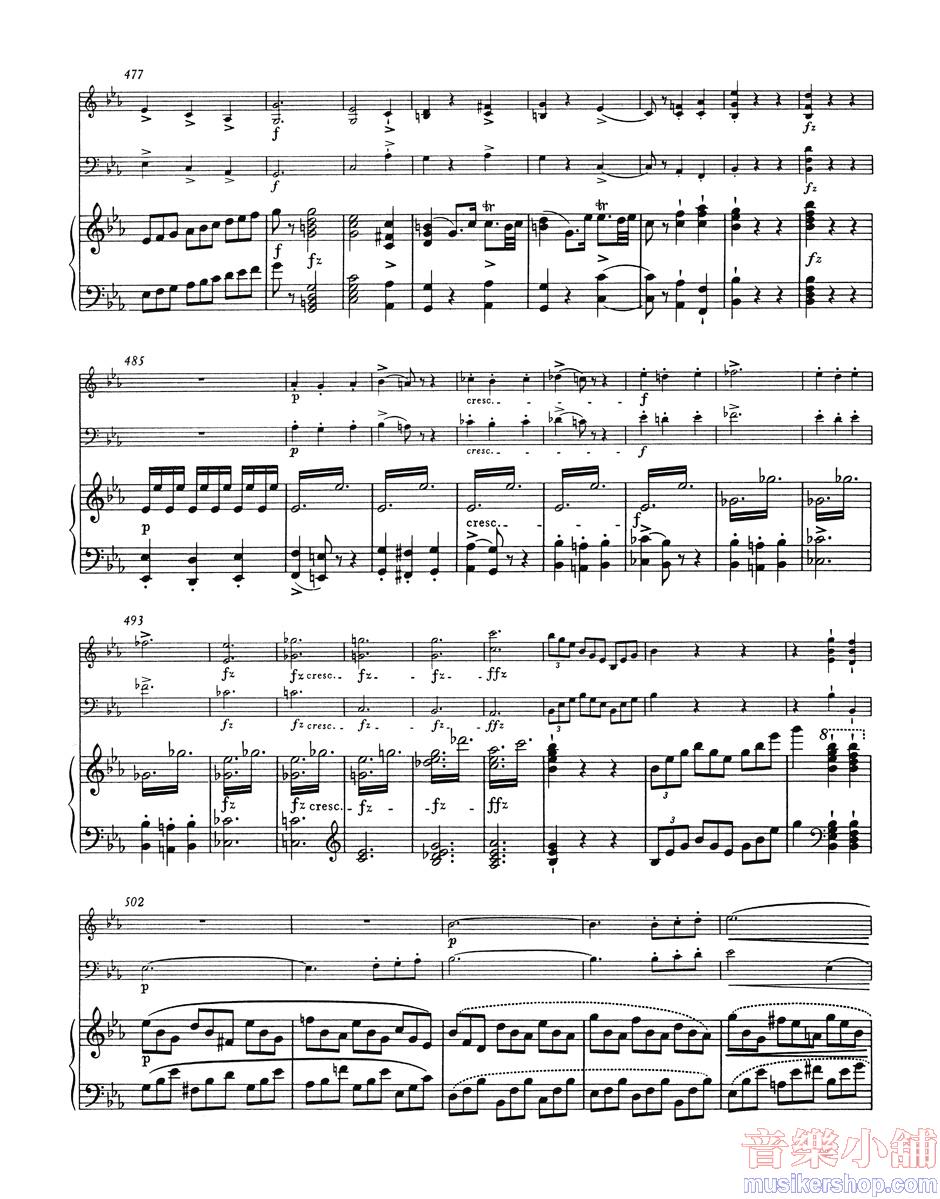
商品描述
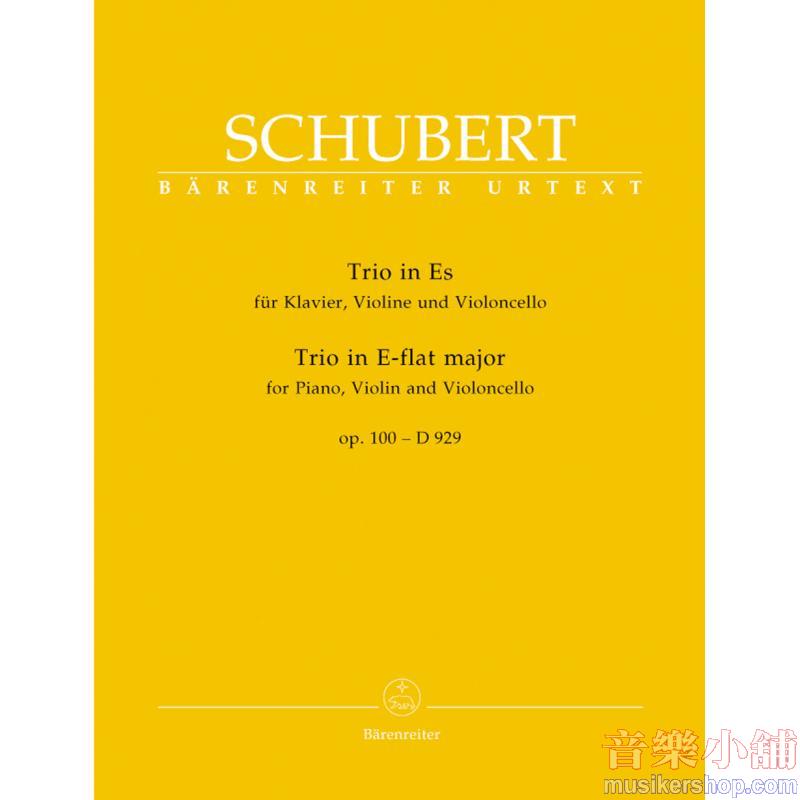
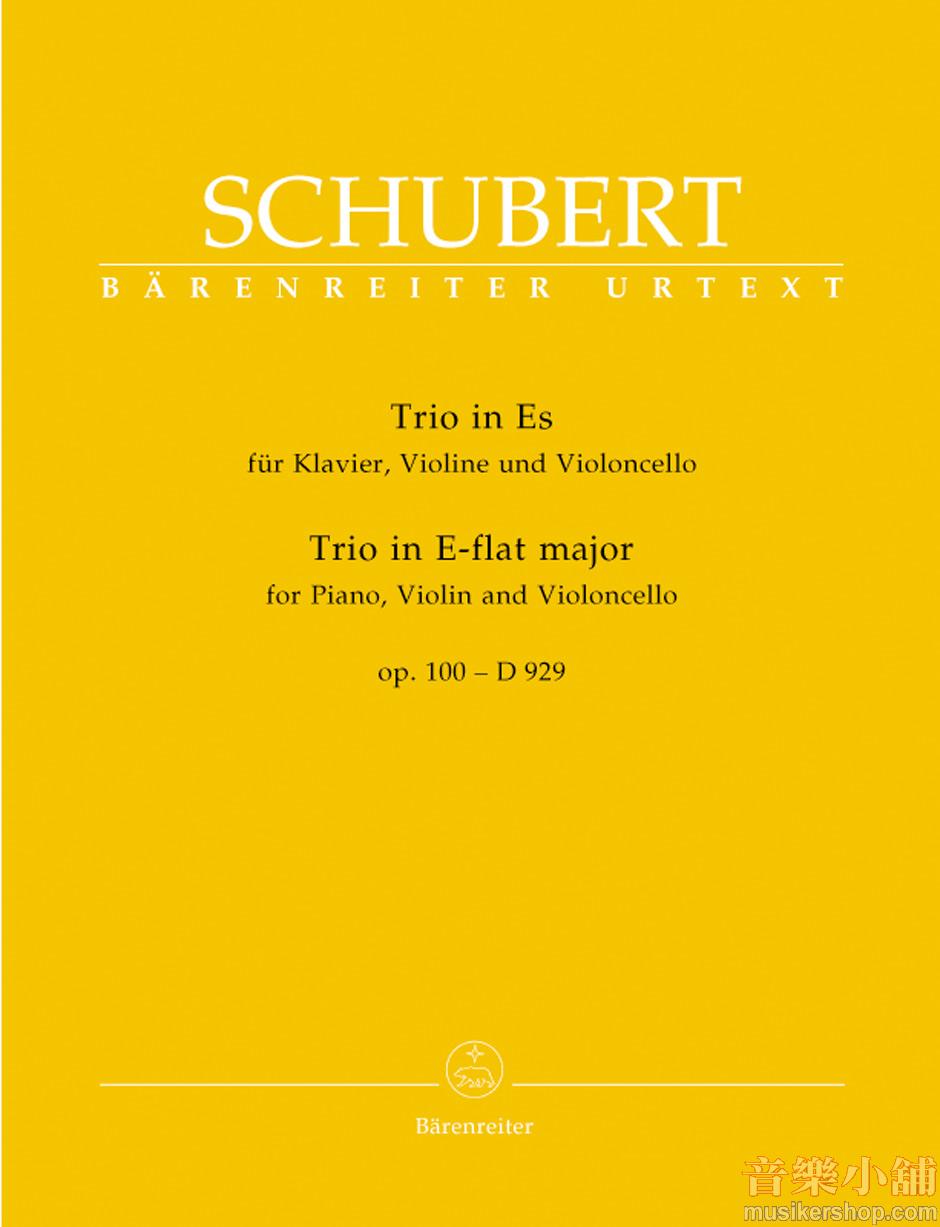
Franz Schubert: Trio for Piano, Violin, and Violoncello in E-flat major, Op. 100, D 929
Edition No.: BA5610
Publisher: Bärenreiter
Series: BÄRENREITER URTEXT
Editor: Arnold Feil
Instrumentation: Violin, Violoncello, Piano (Piano Trio)
Product Format: Performance score, Set of parts, Urtext edition
Binding: Paperback
Language: German, English
Pages: 76 (score), 21 (violin part), 23 (cello part)
Dimensions: 31.0 x 24.3 cm
ISBN: 979-0-006-47276-5
Schubert's Piano Trio in E-flat major, Op. 100, hailed by contemporaries as a quintessential chamber music masterpiece, offers a remarkable blend of lyricism and grandeur. This Bärenreiter Urtext Edition presents the original, unabridged version of the final movement, alongside clear markings for performing either the unabridged or shortened version. Renowned musicologist Arnold Feil has meticulously edited this edition, ensuring historical accuracy and facilitating an authentic interpretation.
Performance Tips:
- Highlight the lyrical interplay between the violin and cello in the Andante con moto.
- Emphasize clarity in the piano's role to balance the ensemble dynamics.
- Explore the optional unabridged finale for a deeper understanding of Schubert's full musical intent.
Robert Schumann described this work as "a vision of heaven" — a timeless piece that will captivate both performers and audiences alike.
PREFACE
On 9 February 1828 both B. Schott's Söhne of Mainz, renowned particularly for their publication of Beet-hoven's late works, and also Heinrich Albert Probstof Leipzig approached Schubert with requests forworks for their publishing houses. Schubert repliedto Schott by offering among others works the PianoTrio in E-flat major from 1827, D 929 – op. 100. At first they accepted all the works he offered, but later declined the trio. Only on 10 April did Schubert reply to Probst, who instantly accepted the trio and had it printed at once. The composer had no influence over its editing and saw no proofs; indeed he probably never saw a copy, as it was only announced by Artaria & Co. as available in Vienna on 11 December 1828. This work brought success to its publisher; the first edition of 1100 copies was followed in 1859 by a "Nouvelle Edition" from Probst's successor Kistner, who sold another 1000 copies.
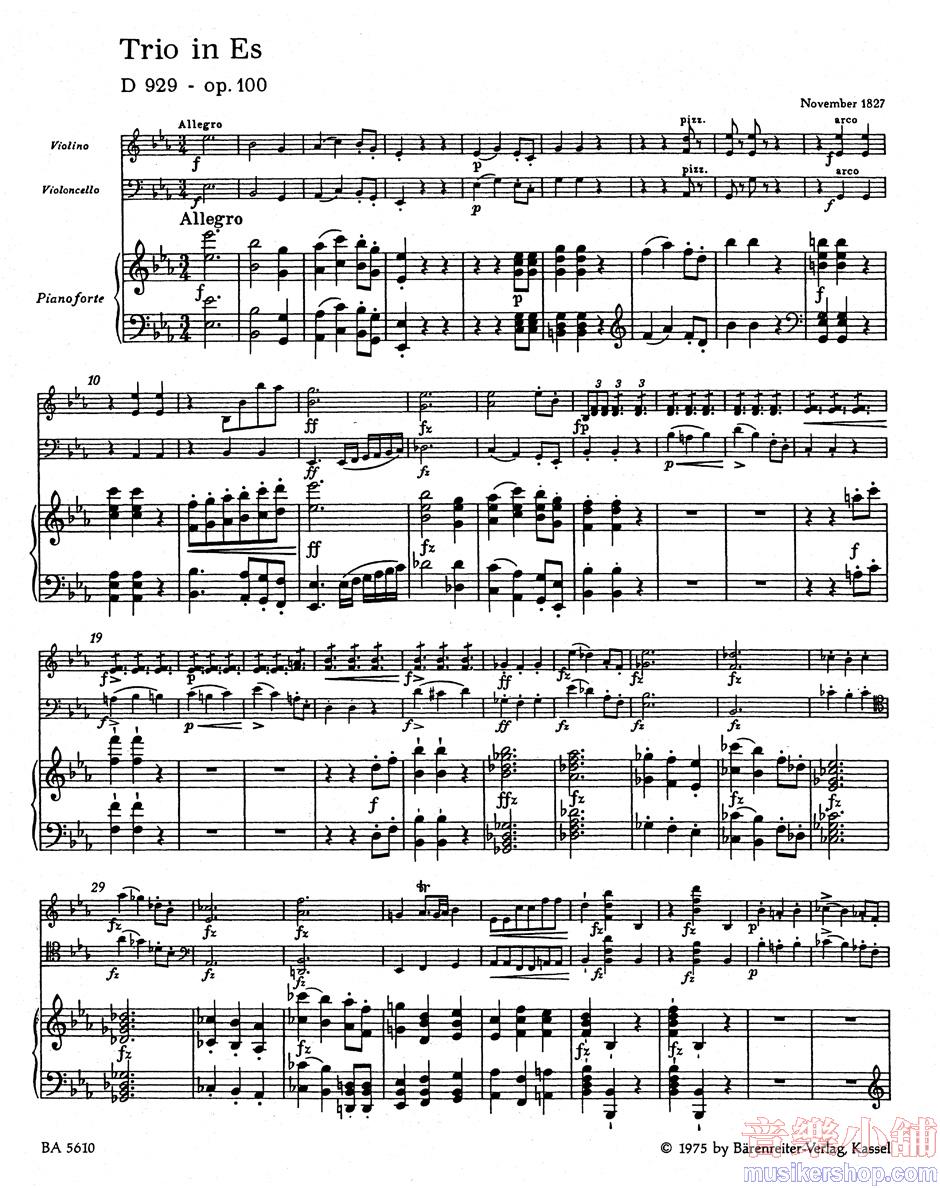
One could assume that Schubert sent the rejected Schott copy on to Probst. It contains the complete last movement, but with marked cuts which Schubert pointed out carefully to the publisher: “The cuts marked in the last piece are to be most strictly observed.” It is not known why Schubert made these cuts and the autograph gives no indications,* but they may conceivably have been made on the occasion of its public performance in Schubert's first and only major concert on 26 March 1828. Of Schubert's friends only L. von Sonnleithner mentions the matter (1857):“One cannot conceal that the trio is too long and has only gained in effect by the new experimental cuts.”In the old Gesamtausgabe and in nearly all other editions, this work follows the original printed version. It was published for the first time in its original version in the Neue Schubert-Ausgabe. The cuts the composer made for the first printed edition have been indicated clearly in the present edition so that either version can be performed.
Schubert himself gives indications on interpretation (letter of 10 May 1828 to Probst): “Let it be performed the first time by proficient musicians and see that particularly in the last piece an even tempo is maintained when the rhythm changes. The minuet [he means the
Scherzando] in moderate tempo [Allegro moderato] always piano but the trio contrastingly forceful, except where it is marked p or pp.”
EDITORIAL NOTE
This publication is based on the editorial principles of the Neue Schubert-Ausgabe and all editorial additions are indicated as follows: letters and numbers by italics (since, however, the numbers 3 and 6 for triplets and sextuplets always appear in italics, additions in this case are printed small); main notes, accidentals before such notes, rests, dots and wedges, fermatas and ornaments by small print; accents and crescendo and decrescendo “hairpins” by lighter print; slurs by broken lines; appoggiaturas and grace-notes as well as accidentals before such notes by square brackets.
The following have been supplied without com ment: accidentals which on the basis of Schubert's style of notation can be taken for granted; precautionary accidentals whose applicability is verified by other parts or analogous passages; missing clefs, missing whole-bar rests; slurs from appoggiatura to principal notes.
Detailed information regarding the origin and history of the work and its sources are found in the Vorwort and Quellen und Lesarten in Volume VI / 7 of the Neue Schubert-Ausgabe (BA 5511).
Arnold Feil
* See Dietrich Berke and Dorothee Hanemann, Zur formalen Organisation des Schlußsatzes aus Franz Schuberts Klaviertrio in Es-dur op. 100 (D 929), in: Festschrift Arno Forchert zum 60. Geburtstag Kassel etc. 1986, pp. 200–207.
舒伯特:《降E大調鋼琴三重奏》,作品100,D 929
版號: BA5610
出版社: Bärenreiter(德國巴倫萊特出版社)
系列: BÄRENREITER URTEXT(巴倫萊特原典系列)
編者: Arnold Feil(阿諾德·費爾)
樂器編制: 小提琴、大提琴、鋼琴(鋼琴三重奏)
產品形式: 樂譜(總譜及分譜),原典版本
裝訂: 平裝
語言: 德文、英文
頁數: 總譜76頁,小提琴分譜21頁,大提琴分譜23頁
尺寸: 31.0 x 24.3 公分
ISMN: 979-0-006-47276-5
舒伯特的《降E大調鋼琴三重奏》自發表以來便被視為鋼琴室內樂作品的典範之作。此版本為巴倫萊特原典系列,收錄了終樂章的原始完整版,並清楚標示可供演奏完整版或刪減版。由著名音樂學者阿諾德·費爾編輯,這部樂譜不僅忠於原著,還為演奏者提供可靠的詮釋參考。
演奏提示:
- 在行板(Andante con moto)中,著重展現小提琴與大提琴之間的歌唱性對話。
- 鋼琴聲部需保持清晰,以確保合奏的平衡感。
- 試探性演奏完整版終樂章,探索舒伯特最完整的創作意圖。
羅伯特·舒曼曾稱這部作品為「宛如天國景象」——無論是演奏者還是聽眾,都能被其深深吸引。
序言
1828年2月9日,緬茲的B. Schott’s Söhne出版社(以出版貝多芬晚期作品著名)與萊比錫的Heinrich Albert Probst出版社同時向舒伯特提出為其出版作品的請求。舒伯特回覆Schott出版社時,推薦了幾部作品,其中包括1827年的《降E大調鋼琴三重奏》(D 929,作品100)。起初,Schott接受了舒伯特提供的所有作品,但後來卻拒絕了這首三重奏。
直到4月10日,舒伯特才回覆Probst出版社,對方立即接受了這部三重奏並迅速付梓。然而,舒伯特對作品的編輯過程毫無影響,甚至可能從未見過最終的譜稿。這部作品直到1828年12月11日才由Artaria & Co.在維也納正式發行。
此作品為出版商帶來了巨大的成功,首版1100冊售罄後,1859年Probst的繼任者Kistner又推出了一版“Nouvelle Edition”(新版本),售出了額外的1000冊。
我們可以推測舒伯特將Schott拒收的版本寄給了Probst。該版本包含完整的終樂章,但標示了清晰的刪減部分,舒伯特特別強調給出版商:“終樂章標記的刪減部分務必嚴格遵守。”目前尚不清楚舒伯特進行刪減的原因,原稿中亦未給出任何線索。然而,這些刪減或許與1828年3月26日舒伯特首次也是唯一一場大型公開音樂會的演出有關。舒伯特的朋友L. von Sonnleithner在1857年提到:“無法否認這首三重奏過於冗長,經過這次試驗性的刪減後,其效果顯著提升。”
舊版的全集以及幾乎所有其他版本均遵循最初的印刷版本。本次新版以**《新舒伯特全集》(Neue Schubert-Ausgabe)**為基礎,首次發表了完整原始版本。此外,編輯在本版本中清晰標示了作曲家為首版印刷所做的刪減部分,讓演奏者可以選擇演奏完整版或刪減版。
舒伯特對詮釋的指示
舒伯特在1828年5月10日給Probst的信中寫道:
“請邀請熟練的音樂家進行首次演出,特別是在終樂章中,節奏改變時需保持穩定的速度。小步舞曲(實際是詼諧曲)應以中速(Allegro moderato)演奏,且全程保持piano,而三重奏部分則需形成鮮明的對比,除非標有p或pp。”
編輯說明
本版本依據**《新舒伯特全集》**的編輯原則,所有編輯補充均以以下方式標示:
- 文字與數字使用斜體(但三連音與六連音的“3”和“6”始終為斜體,因此補充時使用小字)。
- 主音符、裝飾音之前的臨時記號、休止符、附點及楔形符號、延音記號、裝飾音符以小字標示。
- 重音符號及漸強、漸弱標記以較淡印刷顯示。
- 圓滑線以虛線表示。
- 裝飾音符(倚音、倚音音符)及其前的臨時記號使用方括號標示。
以下補充未作標示:
- 基於舒伯特記譜風格的理所當然的臨時記號。
- 經其他聲部或類似樂段驗證適用的提示性臨時記號。
- 遺漏的小節線、整小節休止符、記譜標號。
- 從倚音延伸至主音的圓滑線。
關於該作品的起源、歷史及其來源的詳細信息,請參考**《新舒伯特全集》第VI/7卷(BA 5511)**中的前言及“來源與版本”部分。
阿諾德·費爾(Arnold Feil)
*參見:Dietrich Berke和Dorothee Hanemann,《舒伯特降E大調鋼琴三重奏D 929終樂章的形式組織》,載於《獻給Arno Forchert教授60歲生日論文集》,卡塞爾等地,1986年,第200–207頁。
瀏覽歷史