 商品分類
商品分類 

商品描述
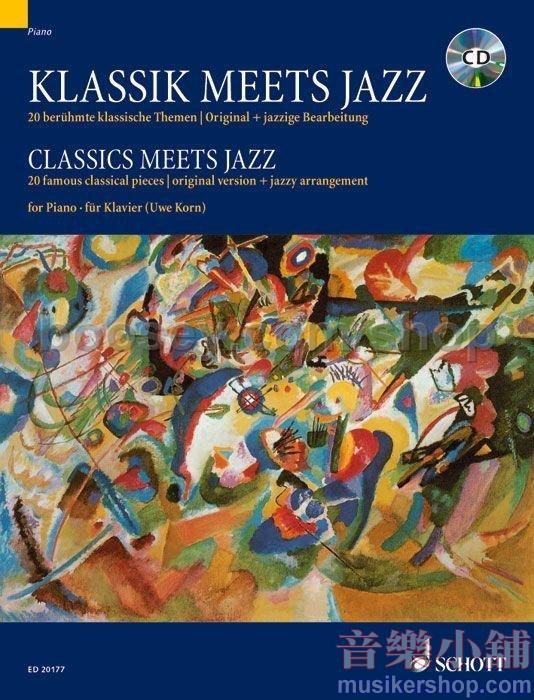
| 20 famous classical pieces, original version + jazzy arrangement | ||||||||||||||||||
| Classics meets Jazz + 1CD 古典遇見爵士 - 20首最喜愛的古典樂曲改編爵士風格鋼琴獨奏曲【第一集】 | ||||||||||||||||||
| 【內容簡介】 | ||||||||||||||||||
|
This volume contains a wide selection of famous musical themes from Bach to Carl Orff. Some of them were originally written for the piano; most have had their scores carefully arranged to make them easy to play on the piano. Each piece is followed with a jazz interpretation, which can either be played alone or alongside the 'original' version. Perhaps this will show that the 'classics' are not all that far removed from jazz, and that music of earlier periods contains many of the essential characteristics of jazz. Doesn't Lully's 'Gavotte', for instance, contain one of the most famous jazz themes ever? The 'Blue Gavotte' may make this clearer. The theme from Mozart's Sonata in A major (K 331) doesn't require many rhythmic changes to give it a blues flavour ('Mozart Goes Blues'). The driving rhythm of the ostinato bass in Carl Orff's 'O Fortuna' would suit modern jazz-rock performers well, with a few small changes ('A Fortune for a Tune'). What do Bizet's 'Habanera', Brahms' 'Hungarian Dance No. 5' and Paganini's 'Caprice No. 24' have in common? Why have they been turned into salsa music ('Habanera con Cigarro', 'Hungarian Salsa No. 5', 'Capriccio Latino')? Much of this is up to the individual: if you want to discover similarities, they are easy to find. It is difficult to convey a jazz interpretation through musical notation alone, so a CD has been included - not to demonstrate the only possible interpretation, but to offer ideas and suggestions. Tango – that's not just a 'classical' dance form but, in addition, pretty much a philosophy of life, yet in any case a 'bath' in the whirlpool of emotions. This volume contains 10 tangos, including such popular pieces as 'Jalousie', 'El Choclo', 'Por una Cabeza' and even more recent classics such as 'Adiós Nonino' by Astor Piazzolla. The arrangement for piano tried to do justice to the specific sound image of the tango as much as possible. Each tango comes together with a jazzy piece in which, in most cases, the preceding tango is newly interpreted in a jazz-related style, but sometimes is combined in pairs with a new composition. Whether it is an arrangement or a new composition, the idea always comes from the tango itself. For instance, the corn cob ('El Choclo') is made into a corn dish with a tangy sauce ('Choclo con Salsa'), while fiery jealousy ('Jalousie') serves to light a Cuban cigar ('Le Cigare Jaloux'). An unhappy lover tries his luck at the races ('Por una Cabeza'), where he might be advised to bet on Spanish horses ('Caballos Españoles'). Astor Piazzolla wrote his piece 'Adiós Nonino' after the death of his father: jazzing this up would be totally inappropriate. The 'Preludio del Ángel' that follows it is a new composition inspired by Piazzolla and Bach.
| ||||||||||||||||||
| ||||||||||||||||||
| ||||||||||||||||||
| ||||||||||||||||||
| 【目錄】 | ||||||||||||||||||
| ||||||||||||||||||
★ 本商品定價如有錯誤時以供應商或出版社之新價格為準,出貨之前會另外通知,不便之處敬請見諒 ★ |


