 商品分類
商品分類 
商品描述
Cinqiuème Concerto Opus 103 (The Egyptian)
Author: Camille Saint-SaënsDescription:
Camille Saint-Saëns’ Piano Concerto No. 5 in F major, Op. 103, popularly known as The Egyptian, was his final piano concerto, composed in 1896. This masterpiece was written for Saint-Saëns’ Jubilee Concert, celebrating the fiftieth anniversary of his debut at the Salle Pleyel.
Nicknamed "The Egyptian," this concerto draws inspiration from Saint-Saëns' travels to Luxor, Egypt, and features exotic influences from Middle Eastern, Javanese, and Spanish music. With its evocative themes and technical brilliance, the piece has become a celebrated part of the piano repertoire. Saint-Saëns himself performed as the soloist at its successful premiere.
Performance Tips:
This concerto requires a pianist with strong technical skills and interpretative depth. Pay attention to the contrasting themes in the first movement, the exotic textures in the Andante, and the energetic transitions of the Molto Allegro. Emphasizing the cultural and geographic inspirations will bring Saint-Saëns’ vision to life.
About the Author:
Camille Saint-Saëns (1835–1921) was a French composer, pianist, and organist, celebrated for his versatility and technical precision. He was a pioneer in French Romantic music and composed numerous works that blend virtuosity with emotional depth. His extensive travels influenced his music, adding unique, global elements to his compositions.
Contents (Movements):
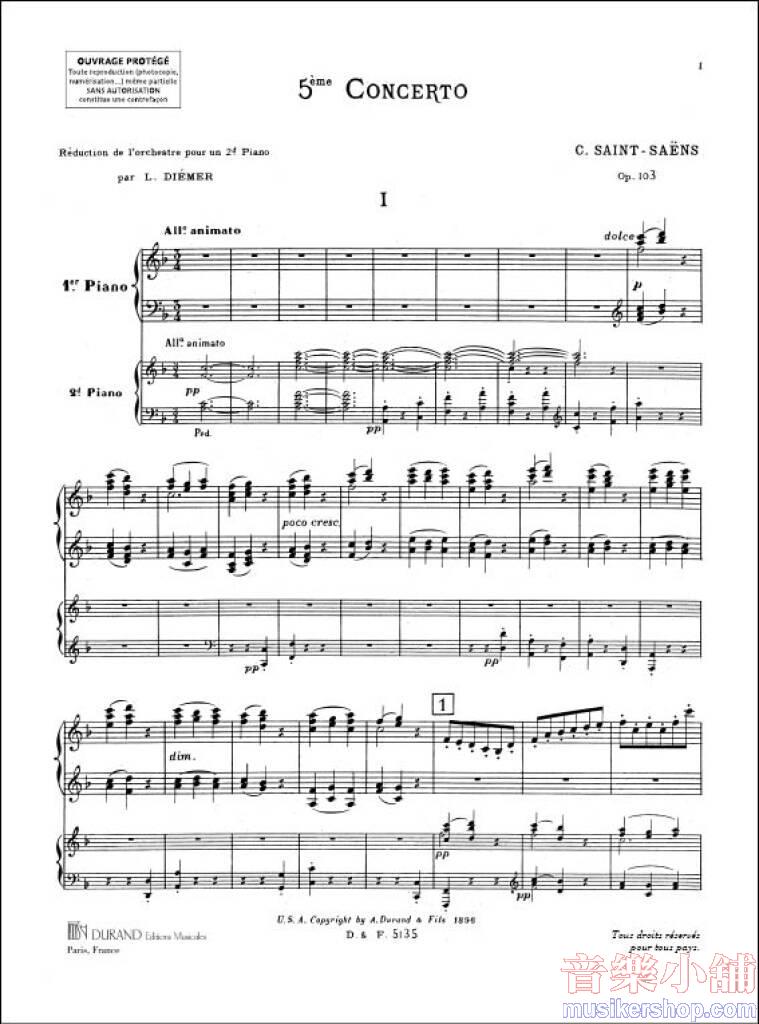
I. Allegro animato
The Allegro animato alternates several times between two contrasting themes. It begins warmly, introducing a simple subject on the piano, which is imbued at each new variation with increasing energy by a brilliant and technically challenging piano part featuring runs up and down the keyboard. This dissolves into a much slower, more melancholic subject, recalling that of the Andante sostenuto movement of Saint-Saëns' second piano concerto. Like waves, the two themes lead into one another until finally the second theme gives way to a gentle coda.
II. Andante
The Andante, traditionally the slow and expressive movement in concerto form, begins literally with a bang; the timpani punctuate an orchestral chord followed by an intensely rhythmic string part and an ascending and descending exotic run on the piano. This exciting introduction segues into the thematic exposition based on a Nubian love song that Saint-Saëns heard boatmen sing as he sailed on the Nile in a 'dahabiah' boat. Lush and exotic, this is the primary manifestation of the Egyptian sounds of the piece and probably the source of the nickname. Toward the end of the section, the piano and orchestra produce impressionistic sounds representing frogs and the chirping of Nile crickets.
III. Molto allegro
The soloist begins the third Molto allegro with low rumbles suggesting the sounds of ships' propellers before exhibiting a vigorous and bustling first theme that rushes all over the piano. The piano continues in its dizzying motion as the woodwinds and strings bring in a driving new melody. The two combine and overlap, creating an active tension that Saint-Saëns uses to great dramatic effect, concluding the movement with a triumphant flourish. He later adapted these themes in 1899 for the Toccata that closes the Opus 111 series of piano études.
Book Details:
- Publisher: Editions Durand
- Series: Piano Concerto Series
- Instrument: Piano or Keyboard
- Language: French
- Product Type: Book [Softcover]
- Difficulty: Intermediate-Advanced
- Binding: Softcover
- ISBN: 9790044027873
- ISMN: DF 00513500
- Pages: 68
聖桑:第五號鋼琴協奏曲 Opus 103(《埃及》)
簡介:
卡米爾·聖桑的《第五號鋼琴協奏曲 F大調,Op. 103》,俗稱《埃及》,是他最後一部鋼琴協奏曲,創作於1896年。這部作品為聖桑的個人金禧音樂會而作,該音樂會紀念他在1846年於Salle Pleyel的首次登台50週年。
此協奏曲之所以被稱為《埃及》,一方面是因為聖桑在埃及盧克索的冬季旅途中完成了這部作品;另一方面,作品融合了中東、爪哇及西班牙音樂的異國風情。聖桑形容這首協奏曲象徵著一次海上旅程,其首演由聖桑親自擔任鋼琴獨奏,廣受好評。
演奏提示:
本協奏曲要求演奏者具備出色的技巧與解讀能力。第一樂章需處理對比鮮明的主題;第二樂章展現異國情調音色;第三樂章的快速變化則充滿活力。演奏者應專注於音樂中的文化與地理靈感,以忠實展現聖桑的音樂視野。
目錄(樂章):
I. Allegro animato
本樂章多次交替兩個對比鮮明的主題,開始於鋼琴上溫暖而簡單的旋律主題,隨後在每次變奏中加入更多能量及挑戰性的技巧,呈現鋼琴快速跑動的絢麗演奏。旋律逐漸轉向更慢、更憂鬱的主題,讓人聯想到聖桑《第二號鋼琴協奏曲》中Andante sostenuto的樂章。這兩個主題如波浪般交融,最終以溫柔的尾聲結束。
II. Andante
本樂章作為傳統協奏曲中的慢樂章,開場十分震撼:定音鼓強調管弦樂和弦,隨後是充滿節奏感的弦樂部與鋼琴的升降異國音階。這一段介紹了聖桑從尼羅河上船夫的努比亞情歌獲得的靈感。這是作品中最具埃及風格的部分,並可能是「埃及」綽號的由來。接近結尾,鋼琴與管弦樂展現了令人印象深刻的蛙鳴及尼羅河蟋蟀的聲音效果。
III. Molto allegro
第三樂章由鋼琴的低音轟鳴開場,模仿船隻螺旋槳聲音,隨後引入熱烈且快速的第一主題,讓鋼琴在鍵盤上奔跑如飛。木管與弦樂加入推進的新旋律,與鋼琴旋律相互交織,形成緊張的戲劇效果,最後以華麗的高潮結束。聖桑後來在1899年改編了這些主題,用於《Opus 111 鋼琴練習曲集》中的結尾托卡塔。
書籍詳細資料:
- 出版社: Editions Durand
- 系列: 鋼琴協奏曲系列
- 樂器別: 鋼琴或鍵盤
- 語言: 法文
- 產品屬性: 書籍 [平裝]
- 難易程度: 中高級
- 裝訂: 平裝
- ISBN: 9790044027873
- ISMN: DF 00513500
- 頁數: 68


