 商品分類
商品分類 
商品描述
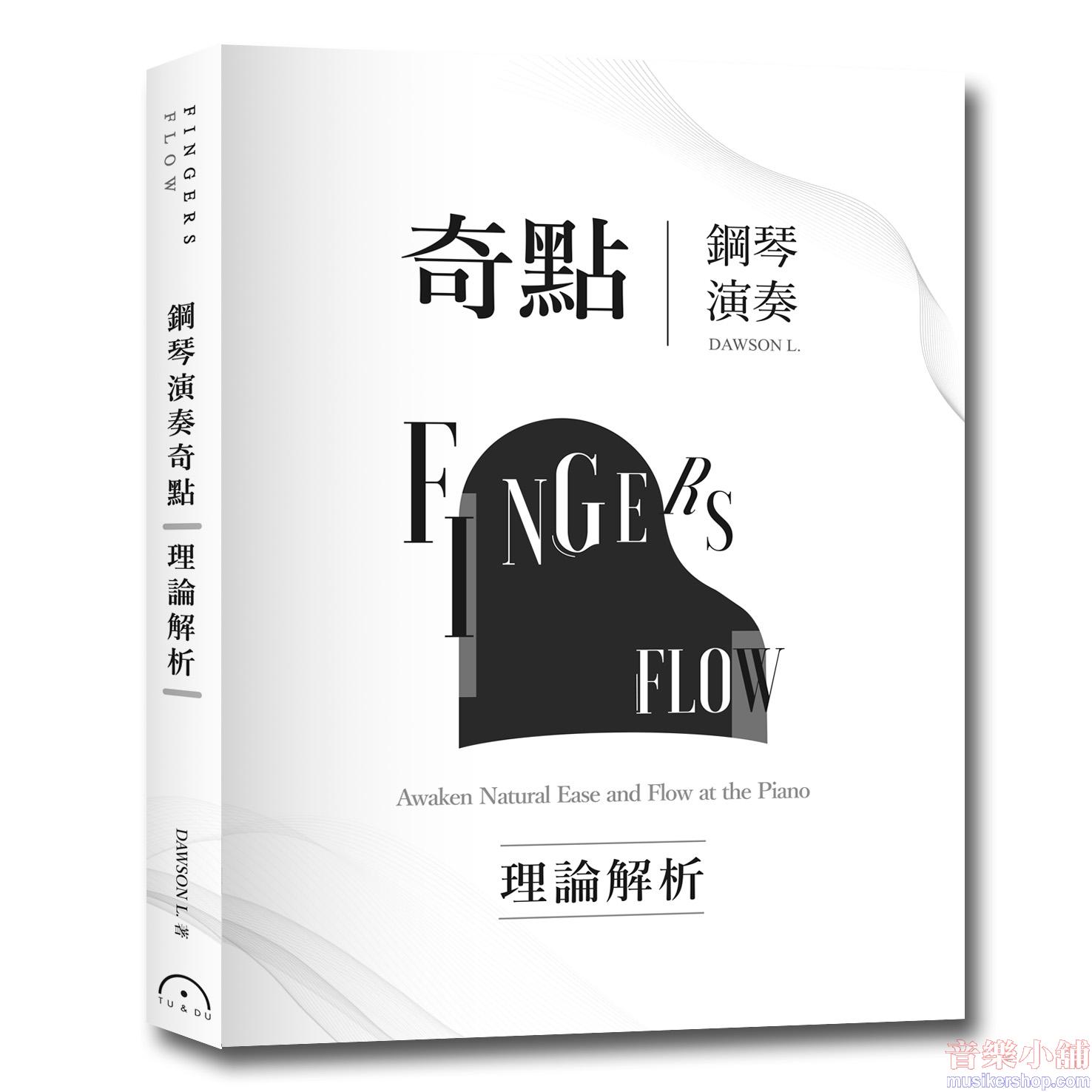
Dawson L : Fingers-Flow 鋼琴演奏奇點 (理論解析)(2版)
內容簡介
為何大師不需要大量練習?改變百年鋼琴演奏思維的奇點!這是一場歷經 25 年全球學習實證的靜默革命,揭開歷代大師不依賴大量練習卻輕鬆駕馭的演奏奧秘,透過學習者自己的雙手親身經歷。25 年的教學與研究中,一種全新的演奏思維逐漸成形:一套可觀察、可驗證、可重複實踐的演奏方法。原本辛勤練習仍無法突破,卻在遠短於預期的時間內完成,這一刻,學習者窺探到屬於歷代鋼琴大師的演奏世界。此書清晰梳理這條道路,並向所有學琴者敞開,從鋼琴演奏奇點出發,看見那個意想不到的真實世界。產品特點
● 一套真正可以實踐+實證的鋼琴練習方法。● 學興趣小朋友,音階自然達到 180BPM。
● 音樂系學生,駕馭始終無法克服、甚至被認為無法完成的樂曲。
● 受傷的學生超越過往,找到更自由的演奏世界。
● 專業推薦:『彈琴,是打開五官,身心全然活在當下的活動。順勢演奏(Fingers-Flow)正是以此為前提,引領學子體會放鬆及支撐的能量,享受彈琴的樂趣。樂見福音問世,嘉惠學子。』——胡文娟,國立臺灣藝術大學音樂系兼任講師。
演奏提示
在練習順勢演奏時,學習者必須隨時保持自我覺察。第一部著重於「放鬆與支撐」的自然掉落與手臂重量感受,並建立正確的手指拱橋支撐結構,避免不正確的指關節凹陷。第二部則進一步探討兩音連結的重力轉移,利用省力高效的肌群來取代傳統盲目的苦練。第三部引入安定面與重量滾動,讓覺知成為最佳指南,在慢練中蓄積力量,進而達到輕鬆彈快的流動狀態。作曲家與編者介紹
Dawson L. : 美國紐約市立大學鋼琴演奏碩士,Fingers-Flow 順勢演奏創辦人。目錄
序胡文娟 國立臺灣藝術大學音樂系兼任講師/1
李友淳 台中榮總復健科醫師/2
推薦序/4
發現之旅/11
感謝/19
前言/20
手部疲勞與技巧瓶頸/29
釐清演奏兩大迷思/32
練習注意事項/42
第一部:放鬆與支撐/ 45
第一章 解決鋼琴技巧的關鍵在於順應自然/45
檢視放鬆/47
甩手動作:感受鬆度/48
丟手動作:感受重力/49
放鬆的定義與狀態/53
放鬆等於癱軟嗎/54
放鬆後自然彈奏極強音量/56
關於假性放鬆/57
第一步驟 丟手臂/59
『第一階段』 放鬆掉落/60
『第二階段』 感受手臂重量/61
第二章 垂掛狀態/63
進入放鬆演奏的門徑/63
利用垂掛建立習慣/63
吊橋般的懸臂姿勢/65
垂掛動作練習目的/66
第二步驟 垂掛/71
第三章 手指支撐與拱橋狀態/74
支撐的定義與結構/74
人體足弓與拱橋結構/74
手型預置與外實內虛的拱橋狀態/76
主動推夾的動作V.S.自然形成的拱橋/77
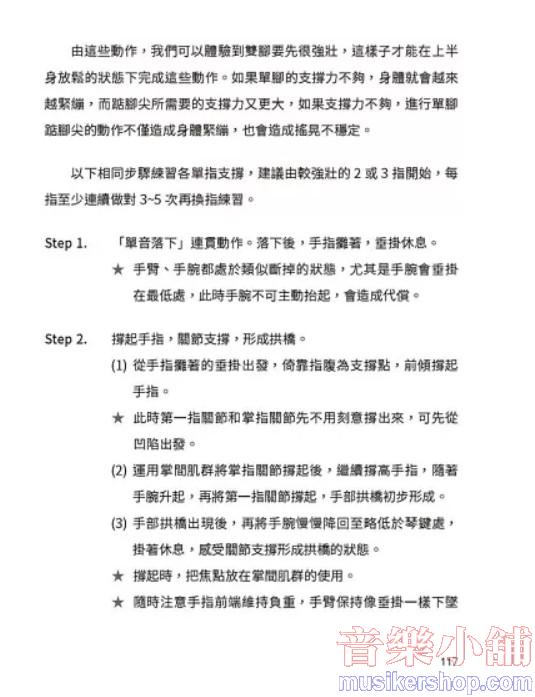
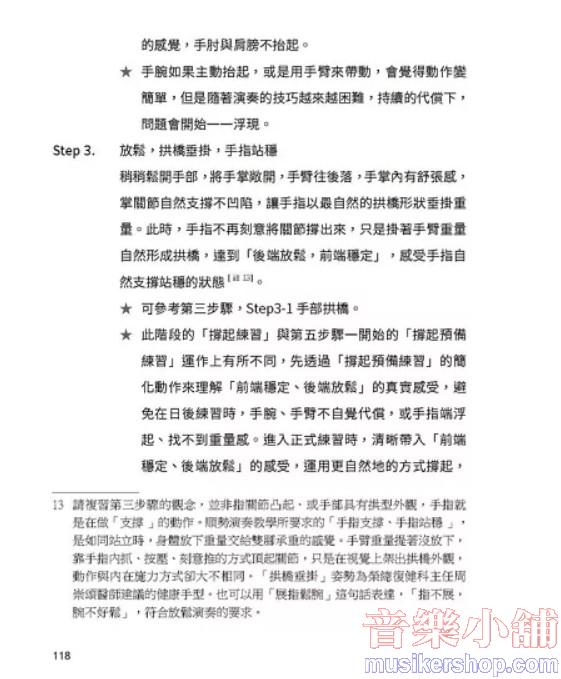
第三步驟 手指支撐與手部拱橋/79
第四步驟 單音落下/86
第四章 手指支撐力的訓練/88
形成支撐力的結構判斷/88
穩定與放鬆並存的支撐狀態/92
手臂屈肌的誤用/94
手指強韌度要求與關節活動/95
徒手訓練動作聯想/99
關於指關節的狀態/102
第一指關節凹陷的緩衝保護/103
第一指關節訓練的必要性/104
常見的指關節凹曲/105
不正確的指關節凹陷/106
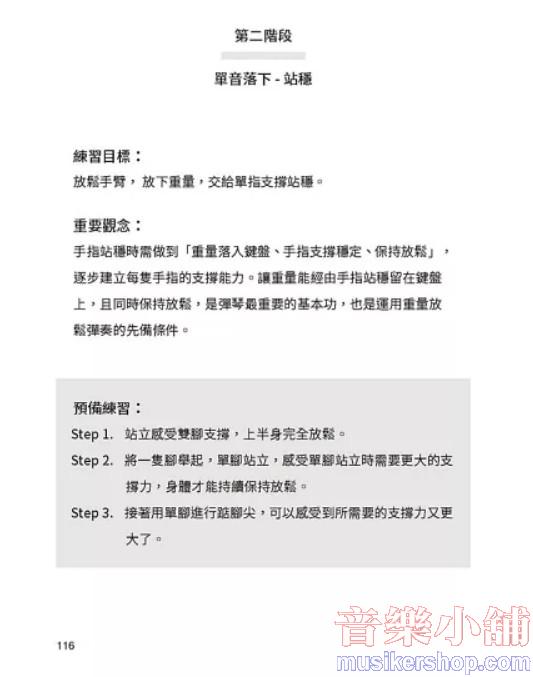
第五步驟 單音支撐/108
『第一階段』 支撐預備與掌間肌群強度練習/108
『第二階段防』 單音落下—站穩/116
常見問題&練習要點
彈奏手型的迷思/126
小手演奏八度的困難/129
「手臂如死屍」的真義/131
練習新觀念「鋼琴長音練習」「隨時隨地可以練琴」/133
特殊情況的練習調整(特殊指型與運動傷害)/137
延伸閱讀
演奏中的力與動能/141
靜力平衡& 施(受)力平衡/152
肌腱的訓練/153
肌腱中的蛋白/154
筋膜的彈性/154
第二部:兩音連結/ 156
第五章 手指靈活度的訓練/156
運用省力高效的肌群演奏/157
瞭解動作發生的訣竅取代苦練/159
第六步驟 手指打水/161
『第一階段』 活動掌指關節、腕掌關節/162
『第二階段』 相鄰手指交互打水/164
第六章 兩音連結的基礎/167
運動的本質源自重心轉移/167
兩音連結的重力轉移/168
彈奏與行走之間/171
手腕的運作狀態/172
釋放手腕力量的練習/173
手腕晃動與手腕平穩/177
第七步驟 兩音連結分解動作/179
站穩—交接—放鬆/180
第八步驟 兩音連結—慢速/185
袋鼠跳動作練習/189
第七章 吸附感/193
檢視手指穩定達標/193
速度臨界點/196
第九步驟 兩音連結—中速/203
第八章 彈性振幅/206
重力與回彈的自然曲線/206
彈性振幅三要點/207
第十步驟 兩音連結—快速/210
第九章 兩音連結的變化與運用/215
高速演奏的思維/215
高速的連動狀態/219
演奏動作中的隱藏奧秘/220
琴鍵上的拋物線/222
第十一步驟 兩音連結:擴指、收指、轉指/224
常見問題&練習要點
讓覺知成為最佳指南/231
誇大動作練習/232
一步到位的模仿/235
允許錯音發生/238
延伸閱讀
作用力與反作用力/241
振盪模式/249
簡諧運動/250
共振現象/252
運球和鋼琴演奏相似之處/256
第三部:流動狀態/ 258
第十章 安定面/260
第十二步驟 安定面與重量滾動/263
從關鍵跑姿看順勢演奏/267
高抬指與貼鍵/270
第十三步驟 手指拉起/271
『第一階段』短倚音練習/273
『第二階段』同方向五指的簡短音型/275
第十一章 演奏中的運動路徑/278
熟悉手腕的運動路徑/278
第十四步驟 重量滾動的路徑/280
『第一階段』 方向單一的簡短音型/281
『第二階段』 安定面的銜接/286
第十二章 驗證重力/293
第十五步驟 手刀/293
第十三章 律動感/296
第十六步驟 用律動感帶領練習/296
運用C大調音階操作練習/297
常見問題&練習要點
活用技巧資料庫/304
覺察手臂運作狀態—發熱、痠痛/312
慢練的功效/314
慢練的力量/318
轉折之境/319
第四部:總結/328
第十四章:教材選擇/328
第十五章:練習心態歷程/332
第十六章:心流/338
結語:順應重力,順勢而為,輕鬆彈快/348
附錄
如何產生更強力度同時快速演奏/354
托在琴鍵上的半觸鍵/359
後記/364
詳細表示
ISBN : 9786269973644出版社 : 原笙國際
規格 : 平裝 / 382頁 / 17 x 23 x 1.9 cm / 普通級 / 單色印刷
尺寸 : 17 x 23 x 1.9 cm
頁數 : 382 頁
版次 : 再版
出版地 : 台灣
出版日期 : 2026/06/26
★ 定價以出版社之最新價格為準,如有異動出貨之前會另外通知,不便之處敬請見諒 ★
Dawson L : Fingers-Flow: Awaken Natural Ease and Flow at the Piano (2nd Edition)
Description/Preface
Why do masters not require excessive practice? This book unveils the "Singularity" that challenges a century of traditional piano thinking. Through 25 years of global validation, this silent revolution reveals the secrets of legendary masters who performed with ease without endless repetition. Dawson L. presents a method that is observable, verifiable, and repeatable, allowing pianists to experience a world of effortless flow and look into the authentic world of master performers.Features
● A practical and evidence-based method for piano practice.● Allows hobbyist children to achieve scale speeds of 180BPM naturally.
● Enables music majors to master pieces previously thought insurmountable.
● Guides injured students to transcend limitations and discover a more liberated performance world.
● Professional endorsement: "Playing the piano is an sensory-opening experience where body and mind live fully in the present. Fingers-Flow leads students to feel the energy of relaxation and support, enjoying the pleasure of piano playing." — Hu Wen-Chuan, Adjunct Instructor, Department of Music, National Taiwan University of Arts.
Performance Tips/Difficulty
When pursuing the Fingers-Flow technique, learners must maintain continuous physical awareness. Part I focuses on relaxation, arm dropping, and establishing a secure hand arch structure while avoiding pseudo-relaxation. Part II trains finger agility through efficient gravity transfer during note connections. Part III guides the player into a fluid state by mapping wrist movement paths, verifying gravity, and cultivating slow practice habits to unlock ultimate speed effortlessly.About Composer/Editor
Dawson L : M.M. in Piano Performance from the City University of New York; Founder of Fingers-Flow.Contents
PrefaceHu Wen-Chuan, Adjunct Instructor, Dept. of Music, National Taiwan University of Arts/1
Lee You-Chun, Rehabilitation Physician, Taichung Veterans General Hospital/2
Recommendation Preface/4
Journey of Discovery/11
Acknowledgements/19
Prologue/20
Hand Fatigue and Technical Bottlenecks/29
Clarifying Two Major Performance Myths/32
Practice Notes/42
Part I: Relaxation and Support/45
Chapter 1: The Key to Piano Technique is Following Nature/45
Examining Relaxation/47
Hand Shaking: Feeling Looseness/48
Hand Dropping: Feeling Gravity/49
Definition and State of Relaxation/53
Does Relaxation Equal Limpness?/54
Naturally Playing Fortissimo After Relaxation/56
About Pseudo-relaxation/57
Step 1: Dropping the Arm/59
Phase 1: Relaxed Fall/60
Phase 2: Feeling the Arm Weight/61
Chapter 2: Hanging State/63
Gateway to Relaxed Performance/63
Building Habits Using Hanging/63
Suspended Arm Posture Like a Suspension Bridge/65
Purpose of Hanging Movement Practice/66
Step 2: Hanging/71
Chapter 3: Finger Support and Arch State/74
Definition and Structure of Support/74
The Human Arch and Bridge Structure/74
Pre-setting Hand Shape and the Arch State (Solid Outside, Hollow Inside)/76
Active Squeezing Movement vs. Naturally Formed Arch/77
Step 3: Finger Support and Hand Arch/79
Step 4: Single Note Fall/86
Chapter 4: Finger Support Training/88
Structural Judgment for Forming Support/88
Support State Where Stability and Relaxation Coexist/92
Misuse of Arm Flexors/94
Requirements for Finger Strength and Joint Movement/95
Bare-handed Training Associations/99
About the State of Finger Joints/102
Buffer Protection for First Finger Joint Collapse/103
Necessity of First Finger Joint Training/104
Common Finger Joint Concavity/105
Incorrect Finger Joint Collapse/106
Step 5: Single Note Support/108
Phase 1: Support Preparation and Intermetacarpal Muscle Strength Practice/108
Phase 2: Single Note Fall—Stable Stand/116
Common Questions & Practice Essentials
Myths of Playing Hand Shapes/126
Difficulties for Small Hands Playing Octaves/129
The True Meaning of "Arm Like a Corpse"/131
New Practice Concepts: "Piano Long Tone Practice" & "Practicing Anywhere, Anytime"/133
Practice Adjustments for Special Cases (Special Fingerings and Sports Injuries)/137
Extended Reading
Force and Kinetic Energy in Performance/141
Static Equilibrium & Force (Reaction) Balance/152
Tendon Training/153
Proteins in Tendons/154
Fascial Elasticity/154
Part II: Two-Note Connection/156
Chapter 5: Finger Agility Training/156
Using Labor-saving and Efficient Muscle Groups for Performance/157
Replacing Hard Practice by Understanding the Secret of Movements/159
Step 6: Finger Fluttering/161
Phase 1: Activating Metacarpophalangeal and Carpometacarpal Joints/162
Phase 2: Alternating Fluttering of Adjacent Fingers/164
Chapter 6: Foundations of Two-Note Connection/167
The Essence of Movement Comes from Gravity Transfer/167
Gravity Transfer in Two-Note Connection/168
Between Playing and Walking/171
The Operating State of the Wrist/172
Practice for Releasing Wrist Force/173
Wrist Shaking vs. Wrist Stability/177
Step 7: Decomposition of Two-Note Connection Movement/179
Standing Firm—Handoff—Relaxation/180
Step 8: Two-Note Connection—Slow Speed/185
Kangaroo Jump Movement Practice/189
Chapter 7: Suction Sensation/193
Checking Finger Stability Standards/193
Critical Speed Point/196
Step 9: Two-Note Connection—Medium Speed/203
Chapter 8: Elastic Amplitude/206
Natural Curve of Gravity and Rebound/206
Three Essentials of Elastic Amplitude/207
Step 10: Two-Note Connection—Fast Speed/210
Chapter 9: Variations and Applications of Two-Note Connection/215
High-speed Performance Thinking/215
High-speed Linked State/219
Hidden Secrets in Performance Movements/220
Parabolic Path on the Keys/222
Step 11: Two-Note Connection: Expansion, Contraction, Turning/224
Common Questions & Practice Essentials
Let Awareness Be the Best Guide/231
Exaggerated Movement Practice/232
One-step Mimicry/235
Allowing Wrong Notes to Occur/238
Extended Reading
Action and Reaction Forces/241
Oscillation Mode/249
Simple Harmonic Motion/250
Resonance Phenomenon/252
Similarities Between Dribbling and Piano Performance/256
Part III: Flow State/258
Chapter 10: Stability Surface/260
Step 12: Stability Surface and Weight Rolling/263
View on Fingers-Flow from "Pose Method" Running/267
High Finger Action vs. Keeping Close to Keys/270
Step 13: Finger Lifting/271
Phase 1: Acciaccatura Practice/273
Phase 2: Short Melodic Patterns of Five Fingers in the Same Direction/275
Chapter 11: Movement Paths in Performance/278
Familiarizing with the Wrist Movement Path/278
Step 14: Weight Rolling Paths/280
Phase 1: Short Melodic Patterns in a Single Direction/281
Phase 2: Connection of Stability Surfaces/286
Chapter 12: Verifying Gravity/293
Step 15: Hand Blade/293
Chapter 13: Sense of Rhythm/296
Step 16: Leading Practice with a Sense of Rhythm/296
C Major Scale Operation Practice/297
Common Questions & Practice Essentials
Utilizing the Technique Database/304
Awareness of Arm Operation State—Heat, Soreness/312
Efficacy of Slow Practice/314
Power of Slow Practice/318
At the Turning Point/319
Part IV: Conclusion/328
Chapter 14: Repertoire Selection/328
Chapter 15: The Mental Journey of Practice/332
Chapter 16: Flow/338
Conclusion: Following Gravity, Acting with the Trend, Playing Fast Easily/348
Appendices
How to Produce Greater Force while Playing Fast Simultaneously/354
The Semi-touch Resting on the Keys/359
Afterword/364
Details
ISBN : 9786269973644Publisher : Yuan Sheng International
Specification : Paperback / 382 pages / 17 x 23 x 1.9 cm / General Level / Monochrome Printing
Size : 17 x 23 x 1.9 cm
Pages : 382 pages
Edition : 2nd Edition
Country of Origin : Taiwan
Release Date : June 26, 2026
★ Prices and availability are subject to change without notice ★


